Your First Takedown
THE MMA FIELD GUIDEStriking · Wrestling · Ground fighting

Your first takedown / learning corner

MMA glossary: The language of the mat

Look up a term, see where it fits in an MMA round and follow a worked example to the relevant tutorial.

A

Anaconda choke

An arm-and-neck submission from a front headlock position.

In MMA a failed shot can put a fighter underneath a front headlock. Recognise the position and stop the drill when the coach calls it.

In a round. A beginner watching a match spots the defender’s head and one arm inside the attacker’s grip.

Read the related tutorial →
Armbar

A joint lock aimed at the elbow.

Someone underneath guard can threaten an arm when the top fighter leaves it isolated. In class, learn to recognise the position and tap early.

In a round. Your partner identifies the isolated arm and releases on the agreed stop signal.

Read the related tutorial →

B

Back control

A position behind the opponent’s torso, often maintained with leg and upper-body control.

A fighter behind the opponent can make it difficult for them to turn and face the threat.

In a round. In a positional round the athlete underneath works to face their partner before the reset.

Read the related tutorial →

Body lock

A clinch grip that connects the arms around a partner’s trunk.

It can connect cage pressure to a change of angle or a supervised takedown.

In a round. Two partners start chest to chest and freeze once a stable body lock appears.

Read the related tutorial →

Butterfly guard

A seated or reclined guard with the feet working as hooks inside the opponent’s legs.

The hooks can help manage distance and disturb balance, while the top fighter may still have striking room.

In a round. The bottom partner uses the inside hooks to change the angle during a no-strikes round.

Read the related tutorial →

C

Cage wrestling

Standing or grounded grappling shaped by the fence.

The wall limits straight-line retreat and changes which way a fighter can turn.

In a round. A defender who cannot step straight back looks for a way to turn off the fence.

Read the related tutorial →

Clinch

A close standing tie where one or both people control the other with their arms or body.

A clinch can link striking range with wrestling, a turn or a clean break.

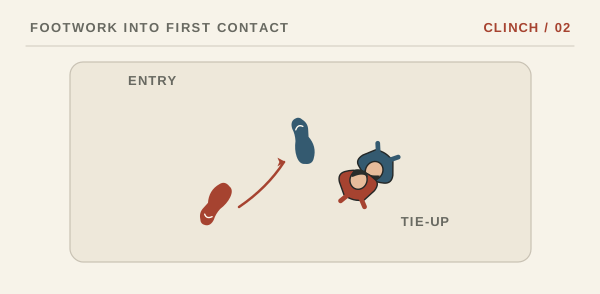
In a round. A drill starts with both partners touching forearms and ends when either gains the agreed tie.

See the position
A lead-foot marker moves toward contact and a pair of overhead upper-body symbols meet inside the training area.
Clinch range changes as both partners move. Ask the coach which tie belongs to the agreed entry before adding resistance.
Read the related tutorial →

D

Double-leg

A takedown entry in which the attacker connects to both legs.

It can follow a change of level when a partner briefly stands within entry range.

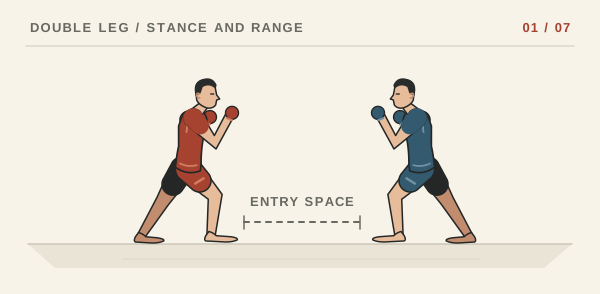
In a round. The coach stops the round after the entry and checks where the attacker’s feet have landed.

See the position
Two staggered stances face one another with a marked gap between the lead feet.
Read the gap from a balanced stance. Check with a coach where the first step can land without a reach.
Read the related tutorial →

F

Frame

A forearm, hand or shin used as a structural barrier between bodies.

A frame can preserve space long enough to recover a guard or build a route to the feet.

In a round. The bottom partner keeps an elbow between both torsos as top pressure arrives.

Read the related tutorial →

G

Ground-and-pound

Striking from a grounded grappling position.

Top position changes which strikes are available and what the bottom fighter needs to protect. Legal targets depend on the rules.

In a round. A coach turns a grappling round into a positioning drill with a glove touch standing in for a strike.

Read the related tutorial →

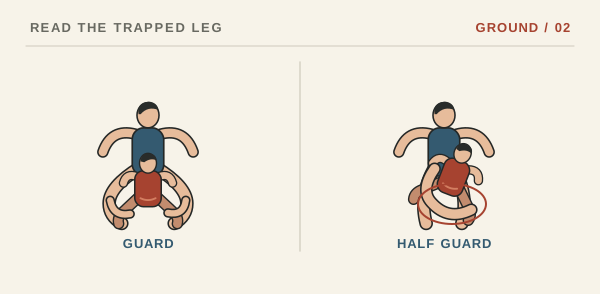
Guard

A family of ground positions in which the lower fighter uses the legs to control the opponent or manage space.

The legs can interrupt pressure or offer a route up, but the lower fighter must still account for punches.

In a round. A partner inside open guard has to get around the legs before settling into side control.

See the position
In guard the legs work around the partner. In the second overhead example one of the top player’s legs is enclosed.
Guard describes a family of positions. In half guard, the bottom player controls one of the top player’s legs with their own legs.
Read the related tutorial →

Guard pulling

Deliberately moving from standing into your own guard.

It can give up top position and expose the lower fighter to strikes. The choice has a different cost in MMA than in submission grappling.

In a round. A grappler who sits to guard now has to deal with an opponent remaining upright.

Read the related tutorial →

H

Half guard

A guard in which the bottom fighter’s legs control one of the top fighter’s legs.

Top pressure and the ability to posture can change the bottom fighter’s priorities.

In a round. In a no-strikes round the lower partner works to recover a second leg between the bodies.

Read the related tutorial →

Hip escape

A movement that shifts the hips away to make space, often called shrimping.

It can help recover a knee or a frame before the top fighter closes the gap.

In a round. A student practises making space for a knee against cooperative side pressure.

Read the related tutorial →

Hook

A curved punch in striking, or a limb used to maintain a connection in grappling.

The same word can mean different jobs. A boxing coach calling for a lead hook wants a punch. A coach asking for back hooks means leg control.

In a round. Listen for the position before interpreting the cue to put a hook in.

Read the related tutorial →

L

Level change

Lowering the body’s working height while keeping a usable base.

A level change can set up a wrestling entry, test a reaction or get underneath a tie.

In a round. In a shadow drill the athlete lowers their level and returns to stance without stepping forward.

Read the related tutorial →

M

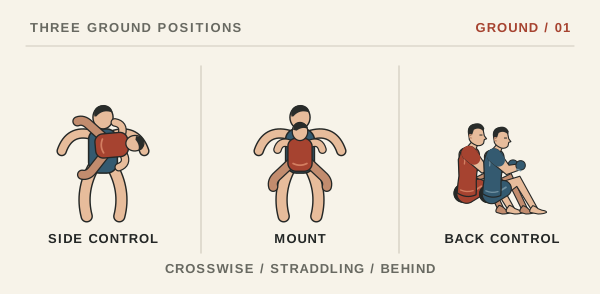
Mount

A top position astride the opponent’s torso.

The top fighter can control the hips or create striking space. The lower fighter needs to account for both threats.

In a round. A positional round starts in low mount and resets if the bottom fighter recovers half guard.

See the position
An overhead side-control view puts the top torso crosswise, a mount view shows a straddle, and seated profiles put the controlling athlete behind for back control.
Start with where the partner sits relative to your hips, shoulders and back. The pictures teach position names. A coach must check the grips and pressure.
Read the related tutorial →

O

Overhook

An arm wrapped over the top of a partner’s upper arm.

An overhook can limit an opponent’s underhook or influence their posture in a clinch.

In a round. A coach freezes an over-under tie and identifies which arm passes above the other.

Read the related tutorial →

P

Penetration step

The entry step that brings a wrestler toward the opponent’s base after changing level.

Reaching with the arms from outside wastes the step. Distance and alignment come first.

In a round. A student crosses a floor marker with a controlled entry before adding a partner.

Read the related tutorial →

S

Scramble

A contested transition in which neither athlete has settled control.

A fighter may have a moment to stand, recover guard or gain top position.

In a round. A takedown lands but both partners are still turning and neither can hold the finish.

Read the related tutorial →

Single-leg

A takedown attack that isolates one leg.

The defender has to protect their remaining base while looking for a way to free the captured leg.

In a round. A coach starts the exercise with one leg already caught and independent balance as the first goal.

Read the related tutorial →

Sprawl

A wrestling defence that takes the hips and legs back from a takedown entry.

A useful sprawl finishes with balance and a route to face the opponent again.

In a round. A student reads a slow level change and practises moving the hips back before a glove reaches their legs.

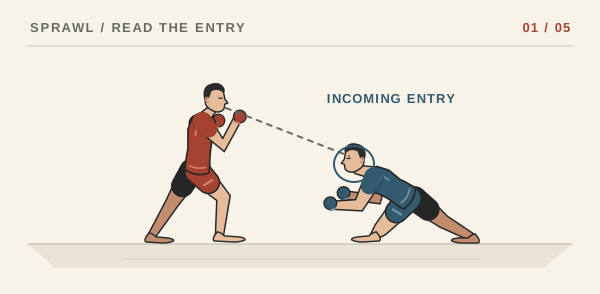
See the position
The blue partner lowers toward the legs. A dashed sight line connects the defender to the change in height.
Read the actual entry and decreasing space. A level change alone can also be a feint.
Read the related tutorial →

U

Underhook

An arm threaded beneath a partner’s upper arm to control their upper body.

An underhook can help a fighter turn, stand or hold position along the fence.

In a round. During pummelling, both partners exchange which arm has inside position.

Read the related tutorial →

W

Whizzer

An active overhook used to apply counterpressure to an opponent’s upper arm or shoulder.

It can help deal with an underhook or some single-leg entries. Foot position still counts.

In a round. A coach distinguishes an arm merely hanging over the partner from an overhook that affects the partner’s balance.

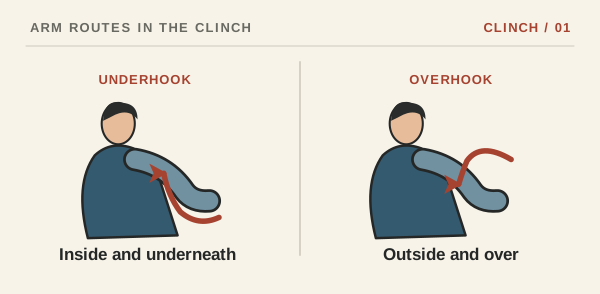
See the position
The first arrow passes beneath the partner’s upper arm. The second passes over the upper arm from the outside.
The position name describes the route of a single arm relative to the partner. The arrows omit grip, head position and pressure.
Read the related tutorial →