
MMA integration
From the takedown landing to top control
Your first job after a takedown is to find out where the other athlete's legs have landed. Being the person on top does not tell you whether you have passed the guard.
The diagrams explain positions and decisions. Independent coach review is pending. Practise contact entries and finishes on mats with a qualified coach.
On this page
Illustrated checkpoints
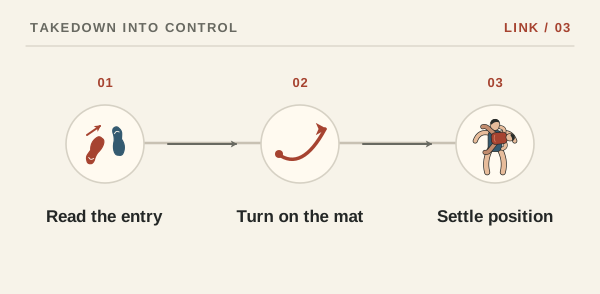
- Land together. Use a pre-agreed, coach-supervised landing.
- Count the trapped legs. Both legs engaged, one trapped, or both cleared?
- Settle on top. Support your own weight and follow one slow turn.
Start from the landing
Before combining skills, both partners need coached falling practice and a controlled takedown. Begin on the floor in three possible end positions. Let your partner wrap both legs, trap one leg or allow you past both. Name the position with your eyes open before trying to move. This prevents an automatic pass attempt into a leg that is still entangled.
Build control that survives a small movement
In top half guard, find a base that lets you stay upright if the lower athlete turns a little. Past the legs, connect to the torso without forcing the neck. Inside full guard, keep enough posture and balance to work with the guard you are actually in. For an MMA drill, note whether lifting one hand would make you fall across the partner.
Connect the two halves
Ask a coach to set a slow takedown with a known landing on a clear mat. Pause, identify guard or control, then let the lower athlete make one agreed movement. If the top partner falls forward or grabs the head, return to the floor-only drill. Add neither strikes nor a rushed submission.