
Striking
Orthodox vs southpaw in MMA: read the open stance
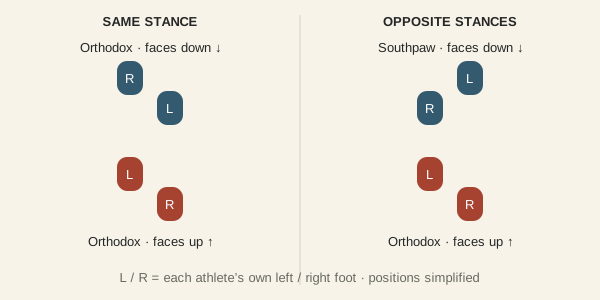
Orthodox leads with the left foot and hand; southpaw leads with the right. When opposite stances meet, the lead sides face each other. Start by recognising that geometry before choosing an angle.
The diagrams explain positions and decisions. Independent coach review is pending. Practise contact entries and finishes on mats with a qualified coach.
On this page
Visual field note
Read the feet before the label
Same-stance matchups are often called closed stance; opposite-stance matchups are called open stance. Neither label tells you how skilled a partner is. A switch of stance changes the picture immediately. Learn your normal stance with your coach before collecting switches.
Outside position is a choice, not a finish
Placing your lead foot outside the opposing lead foot can change the angle for a rear straight. It does not remove the return punch or automatically win the exchange. If you step too far, cross your feet or stare down, you may give away balance while chasing a useful angle.
Kicks and wrestling change the question
The open side changes the route of rear-leg kicks toward the body. The nearest leg for a wrestling entry may also differ from the same-stance picture you first learned. Do not simply mirror a memorised combination: have the coach check distance, head position and the available exit. A narrow stance chosen only to win a punching angle may leave the hips poorly placed to defend a shot.
A non-contact observation round
Original class exercise: place two pairs of foot markers on the mat, facing each other. Name the lead foot in each pair. Change one pair from left lead to right lead and point out which feet now face each other. Do not step on a partner’s feet.
Then shadow one small angle step and stop in balance. Ask your coach whether you could still move back, lift the lead leg or bring your hips away. No kicks, shots or contact are needed to learn the map.
Take one question to class
Ask: “When we face opposite stances, which exit keeps my balance for both the rear kick and the shot?” Record the correction instead of trying to remember a whole new combination.