
MMA Q&A
Why can traditional boxing head movement be dangerous in MMA?
A deep roll can move your head into a kick or knee. A long slip that leaves your weight outside your feet can also delay your answer to a takedown. Small slips, sound footwork and a quick return to stance still have a place.
The diagrams explain positions and decisions. Independent coach review is pending. Practise contact entries and finishes on mats with a qualified coach.
On this page
Visual field note
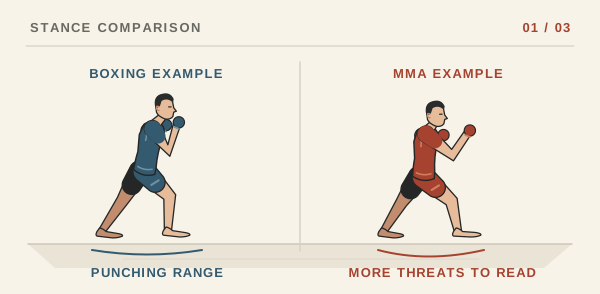
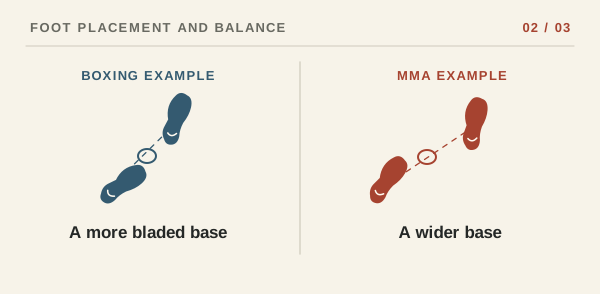
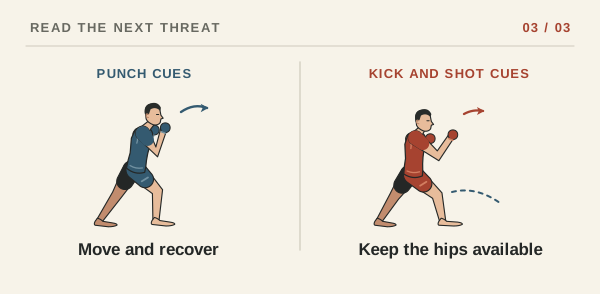
Both athletes need balance. A boxer can organize the stance around punches. An MMA athlete also needs the lead leg and hips available against kicks and takedown attempts.
Read the threat before you choose the defence
In a boxing drill the next shot might be a hook from the other hand. In an MMA drill the partner might clinch, kick or change level instead. An answer learned against a fixed punch combination can take your eyes away just when the rules allow another attack. The problem is the depth, timing and context of the movement.
Use a freeze to check the finish
Ask a coach to show the same slow jab twice without contact. After the first, take one short defensive step and freeze. After the second, add a small slip and freeze. Can you see both shoulders, lift the lead foot or move your hips without an extra recovery step? Ask the coach which option fits the distance.
Take one boxing habit across
Keep looking at the partner and recover a balanced guard after every defence. A coach can introduce a second, signalled threat once the first action looks controlled. Never test this by asking someone to throw a knee at your head.